What Is Zenmux?
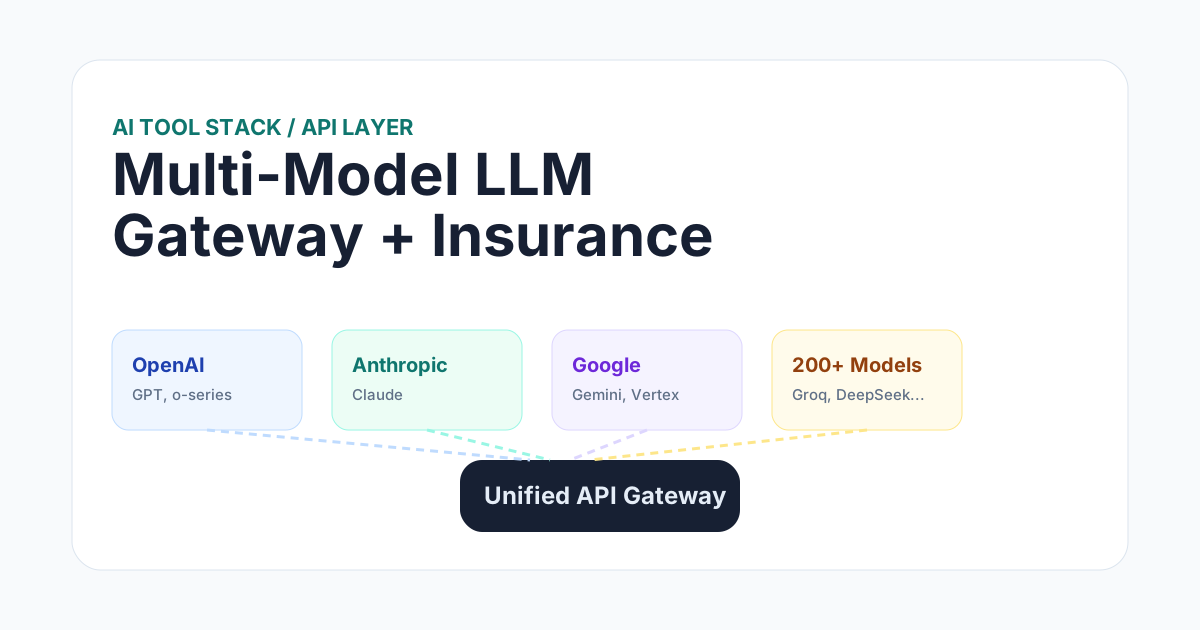
Zenmux is an enterprise LLM platform that acts as a unified API gateway across 200+ AI models. Instead of integrating with OpenAI, Anthropic, Google, Groq, DeepSeek, and other providers separately, teams connect once and route requests intelligently.
The platform offers three API formats in one place:
- OpenAI-compatible for GPT, o-series, and other OpenAI-compatible models.
- Anthropic-compatible for Claude and similar models.
- Vertex AI-compatible for Google Gemini and Vertex-hosted models.
But the real differentiators go deeper than API compatibility.
Three Features That Set Zenmux Apart
1. Unified Multi-Model Access
Most small teams start with one LLM provider, usually OpenAI. Over time, they discover that different models are better at different jobs. Claude may be stronger at long-form reasoning. Gemini may handle multimodal tasks better. DeepSeek may offer comparable quality at much lower cost.
Without a gateway, switching or combining providers means managing multiple API keys, SDK versions, pricing tiers, and rate limits. A unified gateway collapses that complexity into one integration.
2. Intelligent Request Routing
Zenmux can automatically route each request to the most suitable model based on the task type, cost target, latency preference, and quality requirement.
This is useful for small teams that cannot afford a full-time ML ops person. You set the routing rules once, and the platform handles the rest.
Example routing logic:
- Simple classification or summarization goes to a fast, cheap model.
- High-stakes analysis or customer-facing writing goes to a stronger reasoning model.
- Image or multimodal tasks go to models optimized for those inputs.
3. AI Model Insurance
This is the feature that makes Zenmux unusual.
Even the best LLMs produce hallucinations, outdated information, or low-quality outputs. Zenmux offers AI Model Insurance that compensates users when model outputs are subpar.
For a small business owner who needs reliable AI outputs for client work, internal reporting, or customer-facing content, this insurance layer reduces the downside risk of relying on AI.
Most AI tools charge per token and offer no compensation when the output is wrong. Zenmux flips that model: if the model fails, you are not the one eating the cost.
Who Zenmux Is For
Zenmux is not primarily for casual ChatGPT users. It is built for teams that integrate AI into their stack:
- Developers building AI features who want one API instead of five.
- Small SaaS teams that need to test multiple models without rewriting integration code.
- AI consultants and agencies serving clients across different model preferences.
- Content and marketing teams that want quality guarantees on AI-generated material.
- Founders who want to avoid vendor lock-in as their AI usage scales.
How Zenmux Fits the AI Tool Stack
In the AIGCWow AI tool stack framework, Zenmux sits in the agent and API layer. It replaces the need to manage multiple LLM provider accounts and gives teams a single integration point for model access, routing logic, and output insurance.
A common small-team AI stack might look like this:
- Visibility layer: AIGCWow GEO Checklist and structured content pages.
- Content operations layer: Workflows for turning source material into articles, emails, and social posts.
- API / agent layer: Zenmux as the unified LLM gateway, routing content, research, and QA tasks to the right model.
- Analytics layer: Tracking which models produce the best outputs for each job.
- Governance layer: Human review rules, approved model lists, and output quality standards.
Getting Started
For teams evaluating whether a multi-model gateway is worth it, the first step is simple: identify two or three distinct AI tasks you run regularly, then test whether different models produce noticeably different results.
If you currently use only one LLM provider and your outputs are reliable enough, a gateway may not be urgent. But if you have tasks that vary in complexity, cost sensitivity, or reliability requirements, a routing layer can reduce cost and improve output quality.
Zenmux is accessible at zenmux.ai and offers OpenAI-compatible, Anthropic-compatible, and Vertex AI-compatible endpoints. The platform includes documentation, a model catalog, and chat environment for testing before integration.
Affiliate disclosure: Some links in this article are affiliate links. If you sign up through the AIGCWow affiliate link, we may earn a commission at no extra cost to you. Try Zenmux via our affiliate link.
When to Consider a Multi-Model Gateway
Ask these questions before adding a gateway to your stack:
- Do you currently use more than one LLM provider?
- Do different tasks in your workflow call for different model strengths?
- Are you worried about provider downtime or pricing changes?
- Would output insurance reduce your anxiety about AI-generated content?
- Is managing multiple API keys and rate limits becoming a maintenance burden?
If you answered yes to two or more, a unified API gateway is worth testing.
The Bottom Line
Zenmux solves three practical problems for AI-powered small teams: provider fragmentation, model selection complexity, and output risk.
The unified API saves integration time. The routing layer reduces cost by matching tasks to appropriate models. The insurance model aligns the platform’s incentives with the user’s need for reliable outputs.
For teams building AI-ready workflows, a multi-model gateway is not the first thing to fix. Business clarity, GEO-ready pages, content workflows, and lead capture come first. But once the foundation is stable, the API layer determines whether your AI usage is flexible, cost-efficient, and resilient to provider changes.
Get started with Zenmux through the AIGCWow affiliate link and test whether a unified LLM gateway fits your AI tool stack.
FAQ
What is Zenmux?
Zenmux is a unified API gateway that gives small teams access to 200+ LLM models from OpenAI, Anthropic, Google, Groq, DeepSeek, and others through a single integration, with intelligent routing and AI Model Insurance that compensates for subpar outputs.
Why would a small team use a multi-model gateway instead of a single provider?
A multi-model gateway prevents vendor lock-in, lets teams route different tasks to the best model for each job, reduces downtime risk, and often saves cost by using cheaper models for simpler tasks while reserving expensive models for high-stakes work.
What is AI Model Insurance?
Zenmux AI Model Insurance compensates users when model outputs are subpar or contain hallucinations, reducing the financial risk of relying on AI-generated content for business decisions.
Related resources
Continue with the AI-Ready Business Checker, GEO Checklist, AI Growth OS Starter Kit, and AI Visibility Audit.
Free download
Free AI-Ready Business Checklist
Get a practical checklist for improving clarity, GEO readiness, lead capture, workflows, and measurement.