The Numbers Behind 30 Billionaires
On June 10, 2026, Paul Graham spoke at Oxford. The title was deliberately provocative: “How to Earn $10 Billion.”
He started with a statistic that few people outside Silicon Valley know.
Y Combinator, the accelerator Graham co-founded in 2005, has funded approximately 6,500 companies. From that pool of founders, about 30 have crossed the ten-figure threshold. More are approaching it.
The probability is not zero. It is not even microscopic. It is a knowable path, and it is built on a mathematical principle that most founders overlook.
The Math That Silences Skeptics
Graham asked the audience to consider a founder whose net worth is currently $2 million, invested in her own company. For her to reach $10 billion, the company needs to grow approximately 500 times.
How long would that take?
If the company is growing at 93% per month, the answer is: log(500, 1.93) = 9.45 months.
That is not a typo. From $2 million to $10 billion in less than ten months, if the growth rate holds.
The audience might object that 93% monthly growth is unrealistic for most companies. Graham does not disagree. He pivots to a more conservative number.
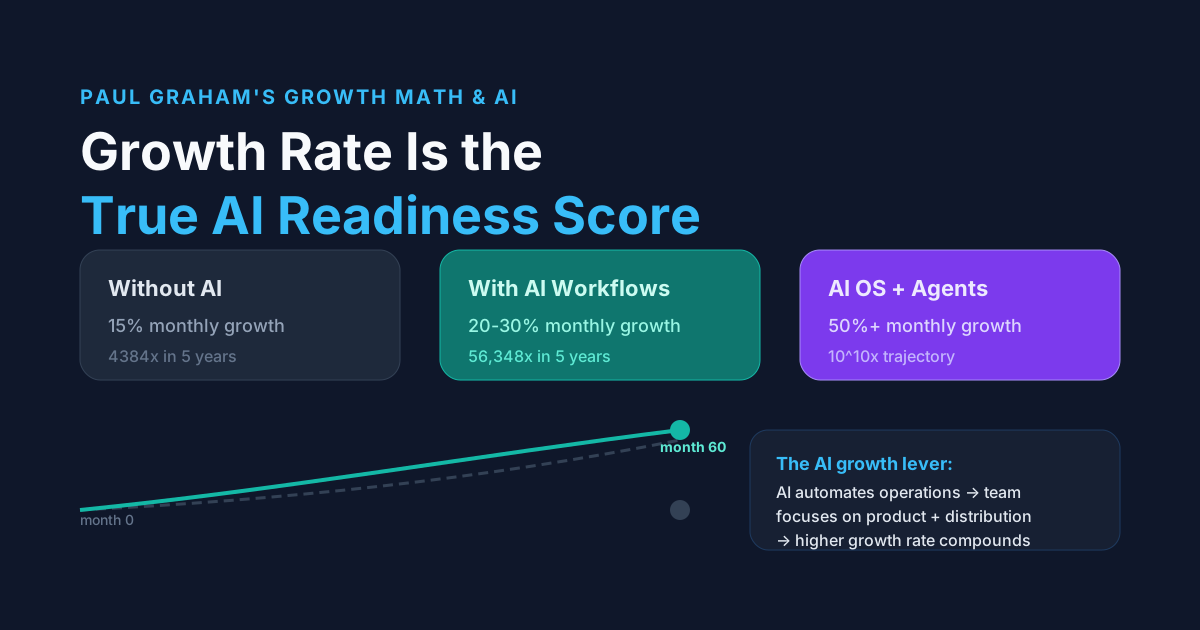
15% monthly growth. That compounds to 4,384x over five years.
If a company is doing $10,000 in monthly revenue today, at 15% monthly growth, it will do $43.8 million per month in five years. Annual revenue: $526 million. The founder with significant equity: a billionaire.
Graham emphasizes this because the numbers are not hypothetical. Many Y Combinator companies have sustained growth rates at or above 15% per month. The math is achievable. The question is: what makes it achievable?
Why Graham Always Asks About Growth Rate First
“I always ask founders about their growth rate. That is not just because I want to know how fast their startup is growing. Growth rate reveals whether they have made something people genuinely want.”
This is the core insight. Growth rate is not just a metric. It is a signal of product-market fit. High growth means the product solves a real problem for real people who tell other people about it.
But there is a second variable that Graham does not state directly in the speech. It is implied in the Y Combinator model: operational bandwidth.
Y Combinator gives founders money, advice, and network access. All three reduce operational drag. Founders spend less time fundraising, less time figuring out basics, and more time building product and expanding distribution.
For small teams outside the Y Combinator ecosystem, the operational drag is the silent killer of compound growth.
The Hidden Variable: Operational Drag
Every hour a founder spends on operations is an hour not spent on product or distribution. The math is brutal:
- A two-person team has roughly 80 productive hours per week.
- If 50 hours go to operations (content, research, lead handling, reporting, QA), only 30 remain for product and distribution.
- That is a 37% growth ceiling imposed by operational bandwidth, no matter how good the product is.
Graham’s 15% monthly growth rate requires sustained focus on what moves the needle: making the product better and getting it in front of more people. Every operational task that can be systematized, automated, or accelerated directly feeds the growth rate.
This is where AI workflows enter the equation. Not as a replacement for product thinking. As a replacement for the operational overhead that consumes the hours Graham’s math depends on.
What Small Teams Can Learn From 30 Y Combinator Billionaires
The 30 founders who crossed the ten-figure threshold share patterns that matter for teams at any scale:
-
They built something people genuinely wanted. This is not a slogan. It means the product solved a problem so well that users became distributors.
-
They sustained growth over years, not months. Compound growth requires duration. A spike month followed by a flat month destroys the curve. Consistency is the multiplier.
-
They stayed focused on the growth rate itself. Graham notes that when a founder knows their growth rate, they know whether their recent decisions worked. The rate gives real-time feedback that revenue totals or vanity metrics cannot.
-
They operated in large markets. Growth rate matters. Growth duration matters. But both must happen inside a market large enough to absorb exponential expansion without saturating.
For small teams, the lesson is clear: reduce everything that is not product improvement or distribution expansion to the smallest possible time allocation, and reinvest every recovered hour into the growth rate.
The AI Amplification Thesis
Graham’s speech is about founders and startups. But the growth math applies to any team trying to scale output without scaling headcount.
A small team that automates research, content production, page auditing, lead enrichment, and reporting through AI workflows is not “using AI for efficiency.” It is buying back the hours that compound growth requires.
The calculation is simple:
- Without AI: 50% of team hours on operations, 50% on product and distribution. Growth ceiling: limited by operational drag.
- With AI workflows: 20% of team hours on operations, 80% on product and distribution. Growth ceiling: lifted by recovered bandwidth.
The difference between these two states is not marginal. Over five years, a 15% growth rate produces 4,384x. A 20% growth rate, sustained because the team is no longer bottlenecked by operations, produces 56,348x.
The AI does not create the growth. It removes the friction that prevents it.
Build for Growth Rate, Not for AI Credentials
The most common mistake small teams make with AI is treating it as a credential. They use ChatGPT, they have a prompt library, they feel AI-ready. But their growth rate has not changed.
AI readiness that does not improve growth rate is AI theater.
The teams that cross meaningful financial thresholds are not the ones with the most AI tools. They are the ones whose AI workflows demonstrably increase the hours available for product and distribution. The growth rate tells the truth.
Graham ends his speech with a simple framework: build something people want, enter a large market, sustain the growth rate. The unspoken fourth variable, for teams building outside the Y Combinator ecosystem, is: automate everything that is not building or distributing.
This Week’s Actions
-
Calculate your growth rate. Revenue this month divided by revenue last month. If you do not have revenue yet, use traffic, leads, or qualified conversations. Write it down.
-
Audit your team’s time allocation. How many hours per week go to operations (content, research, reporting, QA, lead handling) versus product and distribution? Be honest.
-
Identify the single highest-drain operational task. Pick one. Build one AI workflow this week to reduce its time cost by at least 50%. Document the prompt, review rule, and success metric.
-
Redirect the recovered hours to distribution. Do not use the saved time for more operations. Use it to get the product in front of more people. That is what Graham’s math rewards.
FAQ
What is Paul Graham's formula for earning $10 billion?
Paul Graham distilled it to two variables: growth rate and growth duration. A 15% monthly growth rate sustained for five years produces a 4,384x revenue multiple. A startup doing $10,000 per month at that rate reaches $43.8 million per month, and a founder with significant equity can become a billionaire.
How many Y Combinator founders have become billionaires?
As of June 2026, Paul Graham estimates about 30 founders from approximately 6,500 Y Combinator-funded companies have become billionaires, with more approaching that threshold.
Why does Paul Graham always ask founders about their growth rate first?
Because growth rate reveals whether the founder has made something people genuinely want. It is the single clearest signal of product-market fit, and it determines almost everything about the company's trajectory.
Related resources
Continue with the AI-Ready Business Checker, GEO Checklist, AI Growth OS Starter Kit, and AI Visibility Audit.
Free download
Free AI-Ready Business Checklist
Get a practical checklist for improving clarity, GEO readiness, lead capture, workflows, and measurement.