The Signal Most People Missed
OpenAI released a dense Codex changelog in late June 2026. Most people scrolled past it. The updates looked like standard release notes: CLI versions, bug fixes, plugin tweaks.
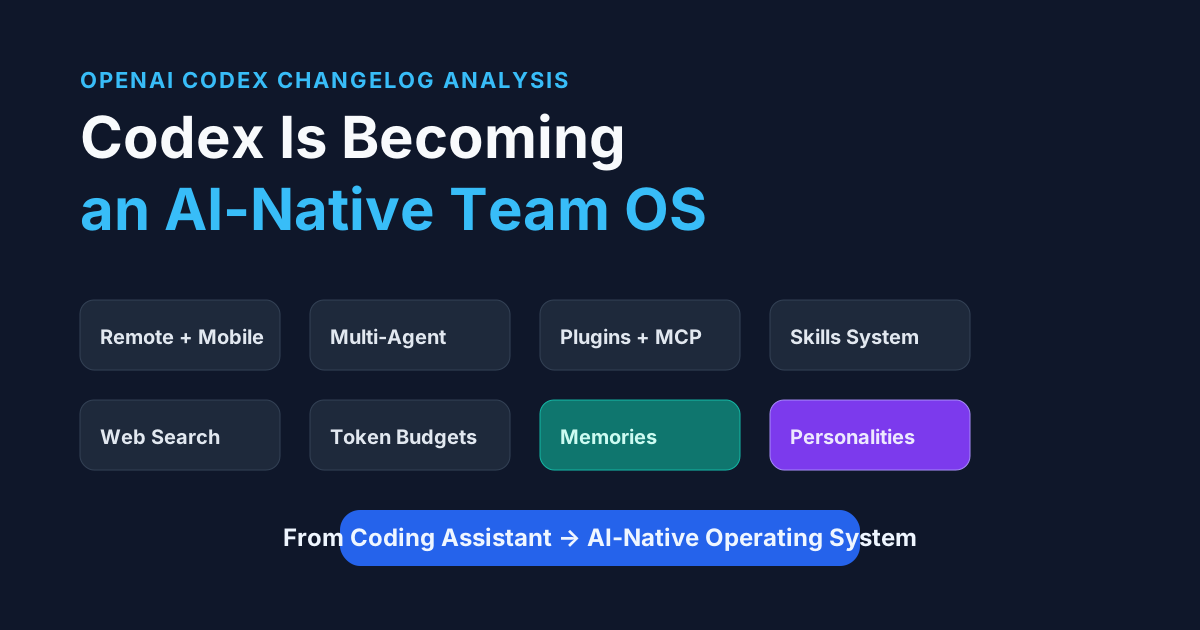
But read across the full changelog and a larger pattern emerges: Codex is no longer a coding assistant. It is becoming an AI-native operating system for how small teams work.
This matters for founders, marketers, operators, and anyone whose business depends on speed, research quality, content output, and repeatable workflows.
This article reads the changelog the way an analyst reads earnings calls: what changed, what it signals, and what small teams should do about it before the pattern becomes obvious to everyone.
The Eight-Layer System Emerging from the Changelog
Every significant feature in the June 2026 release falls into one of eight capability layers. Together, they form a coherent platform:
1. Remote and Mobile: Work Anywhere
Codex Remote reached general availability. You can now start or continue work from the ChatGPT mobile app, connect to a desktop host via authenticated QR pairing, and approve actions from your phone.
A DigitalOcean plugin lets Codex provision cloud servers and connect them as remote workspaces.
For a small team founder, this means: start a research task on your desktop in the morning, review progress from your phone during lunch, approve the output, and return to a finished deliverable.
The geographic and device boundaries that used to define where “work” happens are dissolving.
2. Multi-Agent Orchestration: One Operator, Multiple Agents
Codex can now delegate work to subagents with configurable control: disabled, explicit-request-only, or proactive.
Parent agents receive terminal subagent errors instead of seeing failed work as an empty success. Inter-agent messages now carry join keys for coordination across agent threads.
For small teams, this means one person can operate multiple specialized assistants simultaneously: a research agent gathering data, a content agent drafting, a QA agent reviewing, and a deployment agent publishing.
This is not theoretical. The changelog shows the plumbing is production-ready.
3. Plugin and MCP Ecosystem: Extensible by Default
MCP tools now use tool search by default. Remote plugin catalogs show curated, workspace, and shared sections. Eligible turns can recommend and install relevant plugins.
Plugins support dark-mode logos, object-valued MCP manifests, and marketplace discovery. The ecosystem is being built for scale.
For small teams, this means Codex can connect to your CRM, your analytics, your CMS, your email platform, your database, and your internal tools through a standardized interface.
4. Skills System: Teach Codex Once, Reuse Forever
Skills can be recorded, replayed, shared across the team, and loaded per project. The changelog shows skill metadata reads are parallelized for performance, skill frontmatter is validated and repaired, and skills integrate with the plugin system.
For small teams, this is the equivalent of writing a standard operating procedure once and having a new team member execute it perfectly every time.
5. Web Search: Codex Reads the Internet
An indexed web-search mode allows live searches while restricting direct page access to server-approved URLs. Combined with the existing file-search and retrieval tools, Codex can now consume and reason about web content at scale.
For small teams doing GEO work, this is a critical signal: well-structured, citation-friendly content is not only for Google and ChatGPT. It is also for Codex agents that search, read, and reference web pages as part of their workflow.
6. Token Budgets: Cost Control for Teams
Configurable rollout token budgets track usage across agent threads, provide remaining-budget reminders, and abort turns when exhausted. The /usage command can show and redeem earned usage-limit reset credits.
For small teams with real budgets, this means AI usage can be managed like any other operational expense: allocated, tracked, and capped.
7. Memories and Personalities: Context That Persists
Per-host personality settings now offer Friendly and Pragmatic options. Goals can be edited directly in the composer. Forked conversations link back to the original thread. Memories accumulate across sessions.
For small teams, this means Codex can learn your brand voice, your customer language, your formatting preferences, and your decision rules, then apply them consistently across tasks.
8. Safety and Governance: Enterprise-Ready Guardrails
PowerShell safety classifiers, code-mode model metadata verification, remote image validation, expired credential recovery, and safety-buffering UI metadata all appear in this changelog.
For small teams that handle customer data or operate in regulated industries, these are not just features. They are prerequisites for using AI in production.
Why This Matters for Non-Developers
The most dangerous assumption about Codex is that it is “for engineers.” The June 2026 changelog makes that assumption obsolete.
Here is who should be paying attention now:
| Role | What Codex Can Already Do |
|---|---|
| Content marketer | Research competitors, draft articles, repurpose content, generate social posts, audit pages |
| SEO/GEO specialist | Audit site structure, check internal links, analyze search results, generate structured data |
| Founder/operator | Research leads, prepare sales notes, review analytics, write reports, build landing pages |
| Growth lead | Score leads, generate campaign variants, review performance, suggest experiments |
| Customer success | Summarize tickets, draft responses, identify recurring issues, update documentation |
The common thread: each role involves consuming information, reasoning about it, producing structured output, and repeating the process. That is exactly what Codex is designed to do.
The AI-Native Team Stack
AIGCWow teaches small teams to become AI-ready across clarity, GEO visibility, workflows, lead capture, agents, and measurement. Codex fits directly into the agent and workflow layers of that framework.
Here is how the stack looks with Codex in it:
- Business Clarity: Your positioning, audience definition, and proof live in AGENTS.md and site pages.
- GEO Visibility: Your pages are structured for AI consumption, not just human reading.
- Workflow Layer: Repeatable content, research, and review workflows documented as prompts and checklists.
- Agent Layer: Codex runs the workflows: lead research, content repurposing, GEO audits, campaign QA, weekly reporting.
- Plugin Layer: Codex connects to your CRM, analytics, CMS, and email tools through MCP.
- Measurement Layer: Token budgets, time saved, output quality, lead conversions.
The gap between “using AI occasionally” and “running on an AI-native operating system” is the difference between levels 3 and 8 on the AI proficiency scale.
The GEO Connection
Every week, AI systems become more capable of consuming and acting on web content. Codex now has web search, file search, retrieval, and tool-use capabilities that depend on well-structured sources.
If your business website is unclear, unspecific, or hard for AI to parse, it is not just invisible to Google and ChatGPT. It is invisible to the AI agents that teams are deploying to do research, competitive analysis, and content sourcing.
The GEO principles AIGCWow teaches for AI search visibility also apply to agent consumption:
- Be specific. Agents need to classify, compare, and decide. Vague claims do not help.
- Be structured. Agents parse headings, lists, tables, and sections. Disorganized pages fail silently.
- Be citable. Agents quote, reference, and summarize. Make your content quotable.
- Be connected. Agents follow internal links. Link your pages to form a coherent knowledge graph.
What to Do This Week
You do not need to rebuild your entire business around Codex today. But you should take these four actions before the pattern becomes obvious:
-
Read the June 2026 changelog yourself. Focus on Remote GA, multi-agent orchestration, plugins, and skills. Notice the verbs: provision, orchestrate, delegate, install, search, review.
-
List three recurring tasks in your business that could be delegated to an agent system. Lead research is the most common starting point.
-
Audit one page on your site for agent readability. Can a system that only reads text understand your offer, audience, problem, outcome, proof, and next step?
-
Write a one-page AGENTS.md for your business. Include your positioning, audience, offer, key pages, tools, and decision rules. This is the instruction manual AI systems need to work on your behalf.
Conclusion
The June 2026 Codex changelog is not about bug fixes. It is about infrastructure.
Remote access, multi-agent delegation, plugin ecosystems, skills, web search, token budgets, memories, and governance are not coding features. They are operating system features.
The small teams that treat Codex as a coding tool will get faster code.
The small teams that treat Codex as an AI-native operating system will get faster research, better content, cleaner campaigns, stronger lead pipelines, and a workflow system that competitors cannot easily copy.
The difference is not the tool. The difference is the operating model.
FAQ
What is Codex becoming beyond a coding assistant?
Based on the June 2026 changelog, Codex is evolving into an AI-native team operating system with remote mobile control, multi-agent orchestration, a plugin and MCP ecosystem, a skills system, web search, token budgets, memories, and host personalities.
Do small non-technical teams need to pay attention to Codex?
Yes. Codex Remote GA and the expanding plugin/skills ecosystem mean Codex is increasingly useful for content operations, research, SEO, lead enrichment, reporting, and campaign execution, not just software development.
How does Codex relate to GEO and AI search visibility?
Codex uses web search and tools to consume website content. If your business pages are clear, specific, and well-structured, Codex agents can understand and reference them more accurately, reinforcing the GEO principles AIGCWow teaches.
Related resources
Continue with the AI-Ready Business Checker, GEO Checklist, AI Growth OS Starter Kit, and AI Visibility Audit.
Free download
Free AI-Ready Business Checklist
Get a practical checklist for improving clarity, GEO readiness, lead capture, workflows, and measurement.