
Introduction: AI Won't Replace You. Someone Using AI Better Might.
The biggest risk in the AI era is not that AI will suddenly take every job.
The bigger risk is quieter.
Someone in your market learns how to use AI better. They research faster. They write faster. They test faster. They ship faster.
By the time you notice, they are already ahead.
NVIDIA CEO Jensen Huang has repeatedly made a similar point: the people and companies that learn to use AI well will outperform those who treat it as a toy, shortcut, or occasional writing assistant.
For small teams, this is good news.
You may not have a large budget. You may not have a full engineering department. You may not have a 20-person marketing team.
But with the right AI operating system, you can think, build, test, and distribute like a much larger company.
This article breaks down Jensen Huang's AI philosophy into practical playbooks small teams can use immediately.
1. Stop Using AI as a Crutch
Most people use AI in the weakest possible way.
They open ChatGPT or Claude and type:
"Write me a blog post."
"Give me some marketing ideas."
"Create an ad."
"Summarize this."
Then they copy the first output and move on.
That is not AI leverage. That is outsourcing your thinking to a machine.
The better way is different.
Use AI after you have formed your own view. Use it to challenge your thinking, expand your options, find gaps, structure ideas, and move faster through execution.
AI should not replace your judgment. It should make your judgment sharper.
Practical Rule
Before asking AI for help, write down three things:
- What you already know
- What you are trying to decide
- What a useful answer should include
This small habit changes the quality of everything AI gives you.
Instead of asking:
"Give me marketing ideas for my product."
Ask:
"I sell [product] to [target customer]. My current problem is [specific issue]. I have tried [past attempts]. Give me 5 growth experiments ranked by cost, speed, difficulty, and likelihood of success."
That is the difference between using AI as a shortcut and using AI as a growth partner.
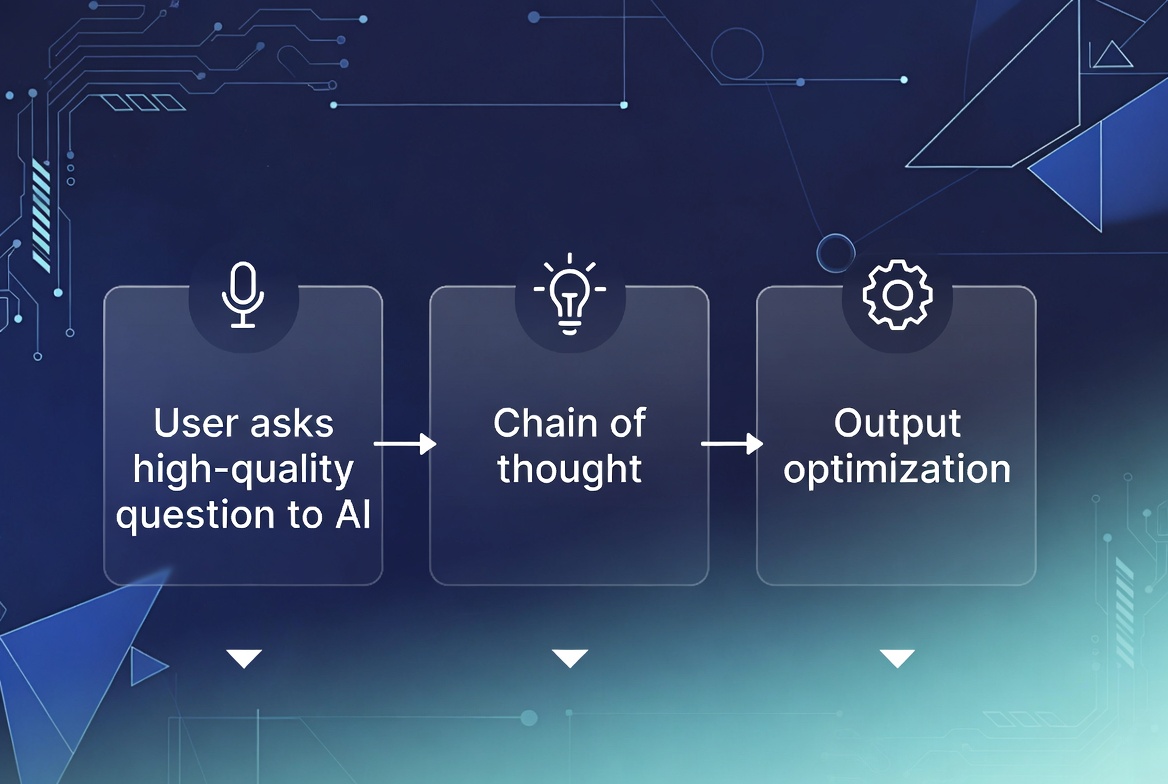
2. Learn to Ask Better Questions
If Jensen Huang were a student today, one of the most valuable skills he would focus on is learning how to ask better questions.
That matters because AI rewards clarity.
Bad input creates generic output. Sharp input creates useful output.
Prompting is not about magic words. It is about thinking clearly enough to direct the machine.
For small teams, this is now a core business skill.
A founder who can ask better questions can research markets faster. A marketer who can ask better questions can produce stronger campaigns. A content creator who can ask better questions can turn one idea into an entire distribution system.
Ready-to-Use Prompt Template
Copy and adapt this:
You are an expert AI Growth Advisor specializing in content marketing, GEO, customer research, and small-team execution.

Context:
I run a [business type] serving [target audience].
Our current goal is [specific goal].
Our main constraint is [budget / time / team size / traffic / conversion rate].

Task:
Help me [specific request].

Requirements:
- Explain your reasoning in clear steps
- Give me 3 distinct options
- For each option, include pros, cons, required effort, and risks
- Recommend the best option for a small team
- Give me a 7-day execution plan
- Output in [Markdown / table / checklist / Notion format]
The key is not the template itself.
The key is the habit behind it: context, constraints, task, evaluation, and next steps.
That is how you turn AI from a chatbot into an operating partner.
3. Turn One-Off Prompts Into Repeatable Workflows
One-off AI usage is helpful.
Repeatable AI workflows are where the real leverage starts.
This is the difference between asking AI to write one article and building an AI-assisted content engine.
A one-off prompt gives you an output. A workflow gives you a system.
Small teams should not try to build complex agents on day one. Start with simple repeatable workflows.
Workflow 1: AI Content Engine
Use AI to support the full content process:
- Find topics your audience is already searching for
- Analyze competitor pages
- Generate an outline
- Draft the article
- Improve the headline and meta description
- Create LinkedIn, X, newsletter, and short-form versions
- Build internal links and CTA blocks
The goal is not to publish more low-quality AI content.
The goal is to turn every good idea into multiple useful assets.
Workflow 2: Weekly Growth Review
Every week, ask AI to help you review:
- What content performed best
- What competitors published
- What keywords or topics are rising
- Which landing pages need improvement
- Which offers or campaigns deserve more testing
Prompt:
Act as my weekly growth analyst.

Here is what happened this week:
[Paste traffic, sales, content, ad, or campaign notes]

Please identify:
1. What worked
2. What did not work
3. What patterns are emerging
4. What we should double down on
5. What we should stop doing
6. The top 3 experiments for next week
This turns AI into a thinking partner for business rhythm, not just content production.
Workflow 3: Lightweight Growth Agent
You do not need a complex autonomous agent to get value.
A lightweight growth agent can simply be a saved workflow that helps with one repeated task, such as:
- Lead research
- Competitor monitoring
- Content repurposing
- Landing page review
- Customer review analysis
- Reddit and community insight mining
- GEO content optimization
Start with one painful recurring task.
If you do it every week, and AI can reduce the time by 50%, it is worth systemizing.
4. Build an AI-Ready Team Rhythm
AI readiness is not about having access to the newest model.
It is about whether your team has built AI into the way it works.
A small team becomes AI-ready when AI is used consistently across research, strategy, creation, testing, and decision support.
Here is a simple weekly checklist.
AI-Ready Weekly Checklist
Every week, your team should:
- Use AI to complete at least 3 tasks that were previously manual
- Save useful prompts into a shared prompt library
- Review AI outputs for accuracy and originality
- Turn one successful prompt into a repeatable workflow
- Track whether AI-assisted work improved a real metric
- Discuss one business problem with AI before making a decision
The last point matters.
AI should not only help you produce more. It should help you think better.
5. Combine AI Literacy With First-Principles Thinking
Jensen Huang often emphasizes first-principles thinking: break a problem down to its fundamentals, then rebuild from there.
This matters even more in the AI era.
AI can generate answers quickly, but speed is dangerous if you are solving the wrong problem.
For example, if your landing page is not converting, the weak AI user asks:
"Rewrite this landing page."
The stronger AI user asks:
"Analyze why this page may not be converting. Look at the target audience, offer clarity, trust signals, objection handling, CTA, page structure, and comparison with competitors. Then recommend what to change first."
The first question asks AI to write.
The second question asks AI to diagnose.
That is the difference.
AI literacy is not just knowing which tool to use. It is knowing how to direct AI toward the real business problem.
Conclusion: AI Is a Multiplier, Not a Shortcut
AI is becoming the new infrastructure layer for business growth.
But infrastructure alone does not create advantage.
The advantage comes from how you use it.
Small teams that treat AI as a shortcut will produce more generic content, more average campaigns, and more noise.
Small teams that treat AI as a growth lever will learn faster, test faster, and build operating systems their competitors cannot easily copy.
The real question is not:
"Can AI do this task?"
The better question is:
"How can we redesign this workflow now that AI exists?"
Start there.
Next Step: Build Your AI-Ready Operating System
Here are three simple actions you can take this week:
- Try the prompt template in this article
- Pick one recurring task and turn it into an AI workflow
- Start a team prompt library and save every useful prompt
Want to go further?
Download the AI-Ready Starter Kit:
- 25 practical prompts for small teams
- 5 workflow templates
- GEO checklist
- AI content engine framework
- Weekly growth review template
Use it to turn AI from a random tool into a repeatable growth system.
Related resources
Continue with the AI-Ready Business Checker, GEO Checklist, AI Growth OS Starter Kit, or AI Visibility Audit.
FAQ
Do small teams need complex AI agents to start? No. Start with one recurring workflow, document the prompt, review the output, and improve it each week.
What should I fix first? Improve the quality of your questions, then turn the best repeatable prompts into shared team workflows.
Free download
Free AI-Ready Business Checklist
Get a practical checklist for improving clarity, GEO readiness, lead capture, workflows, and measurement.