The Situation
A small local service business has a decent website. It looks professional, loads quickly, and explains the service at a basic level. Traditional SEO traffic is stable, but AI assistants rarely mention the business when users ask for recommendations, comparisons, or local service options.
The problem is not that the business is bad. The problem is that the site does not give AI systems enough structured evidence to understand when the business is the right answer.
What AI Search Needs
AI search systems and assistants need more than a polished homepage. They need clear entity signals, specific service descriptions, proof, comparison context, answer-style content, and pages that connect business claims to real outcomes.
In this teardown, the site failed in four places:
- The homepage used broad claims instead of specific positioning.
- The service pages described features but not buyer problems and outcomes.
- The FAQ section answered operational questions but not decision questions.
- The site had testimonials, but they were not connected to services, use cases, or measurable results.
Before: Why the Site Was Hard to Recommend
The homepage headline said the company was “trusted, reliable, and professional.” Those words sound safe, but they do not help an AI assistant decide who the business is best for.
The site also missed important buyer-intent pages:
- No “best for” page explaining ideal customers.
- No comparison page explaining how the service differs from alternatives.
- No pricing or budget guidance.
- No proof page grouping testimonials by customer problem.
- No FAQ answers for objections, timeline, risk, guarantees, or process.
The result: AI systems could read the website, but they could not confidently summarize the business as a strong recommendation.
After: The GEO Fixes
The strongest improvements were structural, not cosmetic.
1. Rewrite the Homepage for Entity Clarity
The new homepage hero answered four questions in plain language:
- Who the business serves.
- What problem it solves.
- What outcome the customer gets.
- Why the business is credible.
This made the business easier for both people and AI systems to classify.
2. Build Use-Case Pages
Instead of one generic service page, the business added use-case pages for the top customer situations. Each page included the problem, signs the customer has the problem, the process, expected outcome, proof, and next step.
3. Turn FAQs Into Decision Support
The FAQ changed from simple logistics to buyer questions:
- How do I know if this service is right for me?
- What happens if I wait too long?
- How does this compare with doing it myself?
- What should I prepare before requesting an estimate?
- What result should I expect in the first 30 days?
These answers are useful for visitors and easy for AI assistants to quote.
4. Connect Proof to Services
Testimonials were rewritten into small proof blocks with context:
- Customer type.
- Original problem.
- Service used.
- Outcome.
- Quote.
This gives AI systems more credible evidence than isolated praise.
The AI-Ready Pattern
The winning pattern is simple: make every important page answer a specific buyer question with proof and a next step.
If your website only says what you sell, AI search may understand the category. If your website explains who it helps, when it is useful, why it works, what proof exists, and what to do next, AI systems have a stronger reason to cite or recommend it.
What to Fix This Week
Start with these five actions:
- Rewrite your homepage headline to include audience, problem, and outcome.
- Add one use-case page for your highest-intent customer problem.
- Add five decision FAQs to your main service page.
- Rewrite three testimonials into proof blocks with context.
- Add a clear audit, checklist, or consultation CTA to every high-intent page.
Why This Matters
AI visibility is not only about keywords. It is about being understandable, specific, credible, and easy to cite.
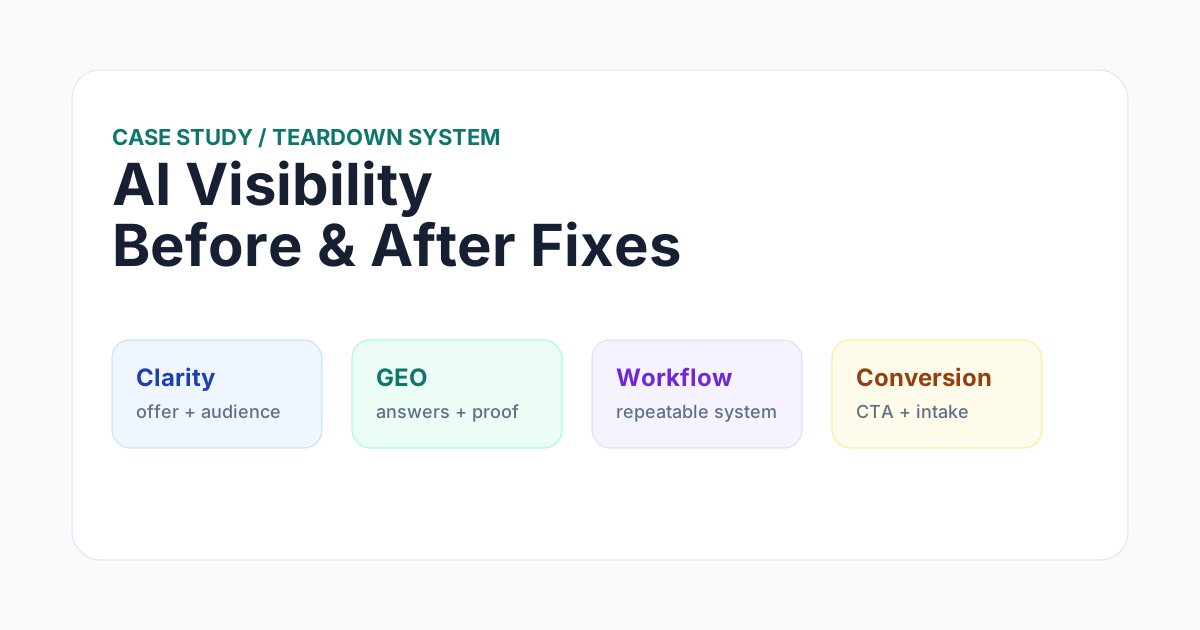
That is why AIGCWow treats AI visibility as part of an operating system: clarity, GEO, workflows, lead capture, and measurement all work together.
FAQ
What is an AI visibility teardown?
An AI visibility teardown reviews whether a business is clear, crawlable, credible, and specific enough for AI assistants and AI search systems to understand, cite, and recommend.
What should a small business fix first for AI visibility?
Start with homepage clarity, service page specificity, proof, FAQ answers, comparison content, and a direct conversion path before adding more AI tools.
Related resources
Continue with the AI-Ready Business Checker, GEO Checklist, AI Growth OS Starter Kit, and AI Visibility Audit.
Free download
Free AI-Ready Business Checklist
Get a practical checklist for improving clarity, GEO readiness, lead capture, workflows, and measurement.