TL;DR
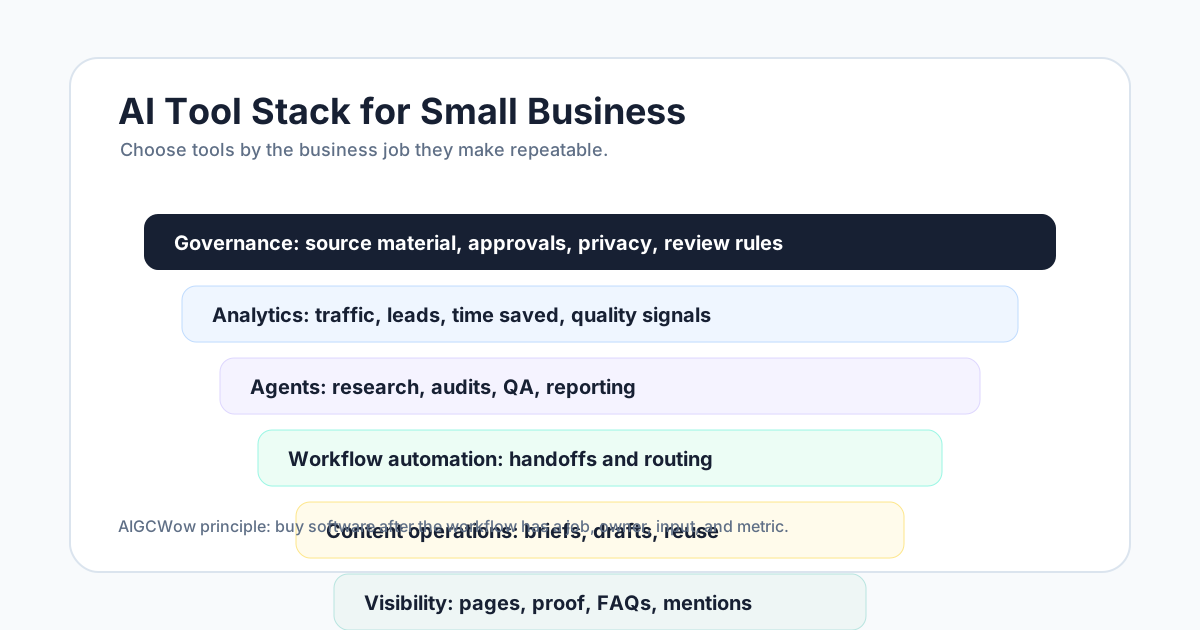
The best AI tool stack for a small business has six layers: visibility, content operations, workflow automation, agents, analytics, and governance. Choose tools only after each layer has a clear business job.
Start with jobs, not logos
A small team does not need a giant AI stack on day one. It needs a clear set of jobs: get found, explain the offer, produce useful content, qualify leads, automate repeatable work, and learn from results.
Definition: AI tool stack for small business
An AI tool stack for small business is the set of software, prompts, workflows, data sources, and review rules a team uses to improve visibility, marketing output, lead handling, automation, and decision-making.
The six-layer AI stack
1. Visibility layer
Your website, structured pages, comparison content, FAQs, public proof, and off-site mentions help AI search systems understand when to recommend you.
2. Content operations layer
Use AI to turn customer questions, sales calls, support tickets, and product notes into useful pages, emails, scripts, and social posts. Do not let AI invent strategy without source material.
3. Workflow automation layer
Automate the handoffs that slow the team down: lead notifications, intake forms, CRM updates, content briefs, research summaries, and weekly reports.
4. Agent layer
Add lightweight agents only after the process is clear. Good first agents include lead research, content repurposing, GEO audits, and campaign QA.
5. Analytics layer
Track traffic, conversions, form quality, sales notes, content output, and workflow time saved. If you cannot measure the job, avoid over-automating it.
6. Governance layer
Define what AI can draft, what humans must approve, where source material lives, and how the team checks accuracy, privacy, and brand voice.
Recommended stack by maturity
- Stage 1: AI-ready website pages, GEO checklist, one content workflow, and a simple lead form.
- Stage 2: Content repurposing workflow, weekly AI marketing rhythm, CRM or spreadsheet tracking, and basic automation.
- Stage 3: Lead research agent, content QA agent, campaign reporting, and documented review standards.
Where affiliate offers can fit later
Tool recommendations should sit inside the layer they help solve. An automation platform belongs in the workflow layer. An API or model platform belongs in the agent layer. A CRM or email tool belongs in the lead capture layer. This keeps recommendations useful instead of feeling like ads.
Worked example: an emotional content business
For a high-ticket emotional video offer such as weddings, proposals, and anniversaries, the stack is narrower: a character-consistent video model such as Higgsfield with Seedance 2.5 for generation, a story intake worksheet, a prompt bank, and a delivery checklist. The full recipe is documented in the AI Emotional Video Workflow, and the sellable system ships inside the Emotional AI Video Playbook. Tool-level comparisons for Higgsfield and Seedance 2.5 live on aigc001.com, with a worked wedding video case study to follow.
Next steps
Check your current baseline with the AI-Ready Business Checker, then use the GEO Checklist, AI Growth OS Starter Kit, and AI Visibility Audit to connect the stack to real business outcomes. Use the AI Marketing Workflow to build one repeatable weekly process.
FAQ
What AI tools does a small business need first?
Start with tools that help the business get found, create useful content from source material, capture leads, automate simple handoffs, and measure what changed.
How should a small team choose an AI tool stack?
Choose by workflow, not by hype. If the team cannot name the job, source material, owner, and success metric, it is too early to add another tool.
Free download
Free AI-Ready Business Checklist
Get a practical checklist for improving clarity, GEO readiness, lead capture, workflows, and measurement.