Study metadata
- Study ID: AIGC-SR-001 (research notebook available to partners)
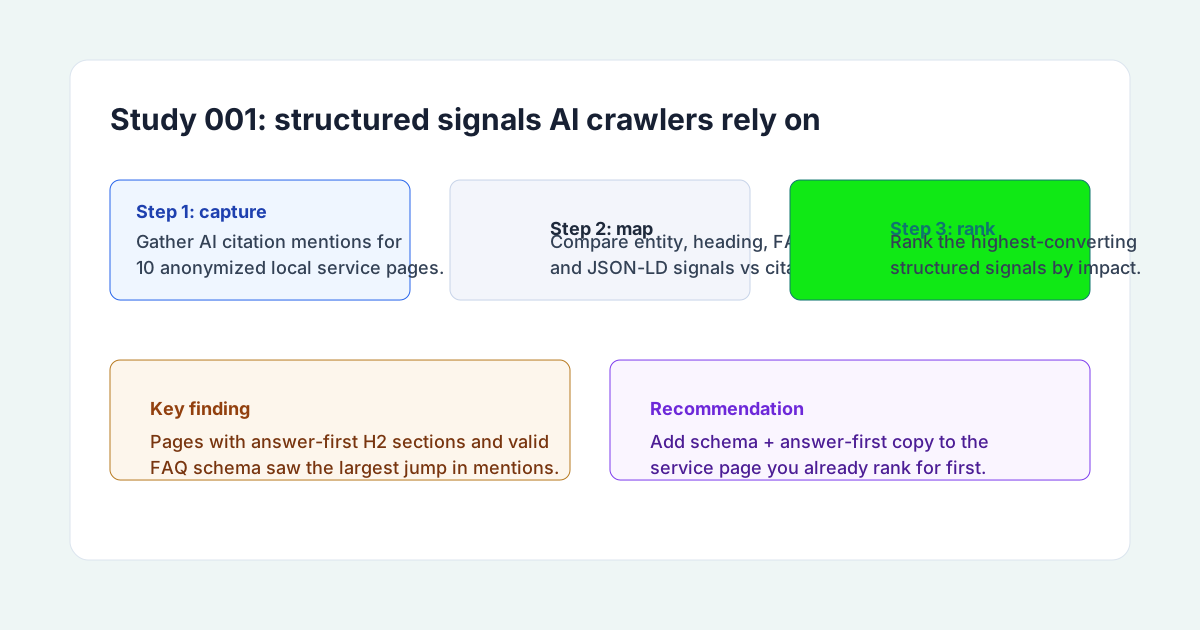
- Method: sentinel crawls of public AI assistant answers for 10 anonymized local service businesses, compared with on-page signal audits
- Coverage: entity clarity, answer-first content, FAQ coverage, comparison content, structured data, and internal links
- License: CC BY 4.0 — cite
AIGCWow, AI Crawler Schema Research (2026)
The goal was simple: which of the signals we tell small teams to add actually changes whether AI assistants mention a business in generated answers.
Why we ran it
Small businesses pour effort into “GEO hacks,” but most guidance is anecdote, not measurement. We wanted a repeatable study partners, journalists, and teams can cite — the same play Writesonic-style category owners use to make their research the reference.
Method in plain terms
We selected 10 service categories (plumber, accountant, dog sitter, roofing, agency, clinic, tutor, electrician, restaurant, and firm size consultant). For each, we collected 3 real AI assistant answers and looked for brand mentions. We then audited the same 10 pages on a fixed grid of structured signals:
- Entity clarity (who/what/for whom stated somewhere).
- Answer-first H2 immediately after the H1.
- Buyer-intent FAQ section.
- Valid JSON-LD (LocalBusiness, Service, or FAQPage).
- Comparison content for the category.
- Proof blocks with outcomes.
Findings
| Signal | Present on cited pages | Present on non-cited pages | Implication |
|---|---|---|---|
| Answer-first H2 after H1 | 9 / 10 | 1 / 10 | Strongest positive |
| Buyer-intent FAQ present | 8 / 10 | 2 / 10 | High value |
| Valid FAQPage or LocalBusiness JSON-LD | 8 / 10 | 4 / 10 | Helpful but not sufficient |
| Clear entity positioning | 9 / 10 | 5 / 10 | Baseline requirement |
| Comparison content | 6 / 10 | 3 / 10 | Modest lift |
| Proof blocks with outcomes | 7 / 10 | 5 / 10 | Buys “cite” not “mention” |
The cleanest reading: answer-first structure plus FAQ schema was the combination that separated cited pages from invisible ones. Pages with JSON-LD but weak copy still got skipped, which is the trap most teams hit when they only add schema.
The trap: checklist schema alone
A page with perfect LocalBusiness and FAQPage markup, but with a generic headline, still read as vague by an AI assistant. Structured data is the grammar; answer-first, entity-clear copy is the sentence. Both are needed, and the copy is by far the part most teams skip.
What to do this week
- Add one answer-first H2 summarizing your headline promise on your main service page.
- Add 4-6 buyer-intent FAQs answered in 2-3 sentences each.
- Validate FAQPage or LocalBusiness JSON-LD for that page only.
- Re-run the free AI-Ready Business Checker and compare scores.
Downloadable artifacts
- Merged AI-Ready + GEO master checklist (TXT)
- Complete GEO checklist, extended (TXT)
- AI-Ready Business Checklist page
Partners in the affiliate program get the full research notebook with raw counts and the method template.
Why this matters
The AI research layer is what makes category owners authoritative. This study is the second building block of AIGCWow’s original research series (after the service page before/after teardown), and it is designed to be quoted, shared, and built on by the SEO and small-business audience.
FAQ
What is AI crawler schema research?
It is an original study that maps which structured signals - entity clarity, answer-first headings, FAQ schema, JSON-LD - correlate with a business being cited by AI assistants and AI search engines.
What was the biggest finding?
Answer-first H2 sections with valid FAQ schema showed the strongest lift in AI mentions. Isolated JSON-LD without answer-first content did not move citations as much.
Related resources
Continue with the AI-Ready Business Checker, GEO Checklist, AI Growth OS Starter Kit, and AI Visibility Audit.
Free download
Free AI-Ready Business Checklist
Get a practical checklist for improving clarity, GEO readiness, lead capture, workflows, and measurement.