TL;DR
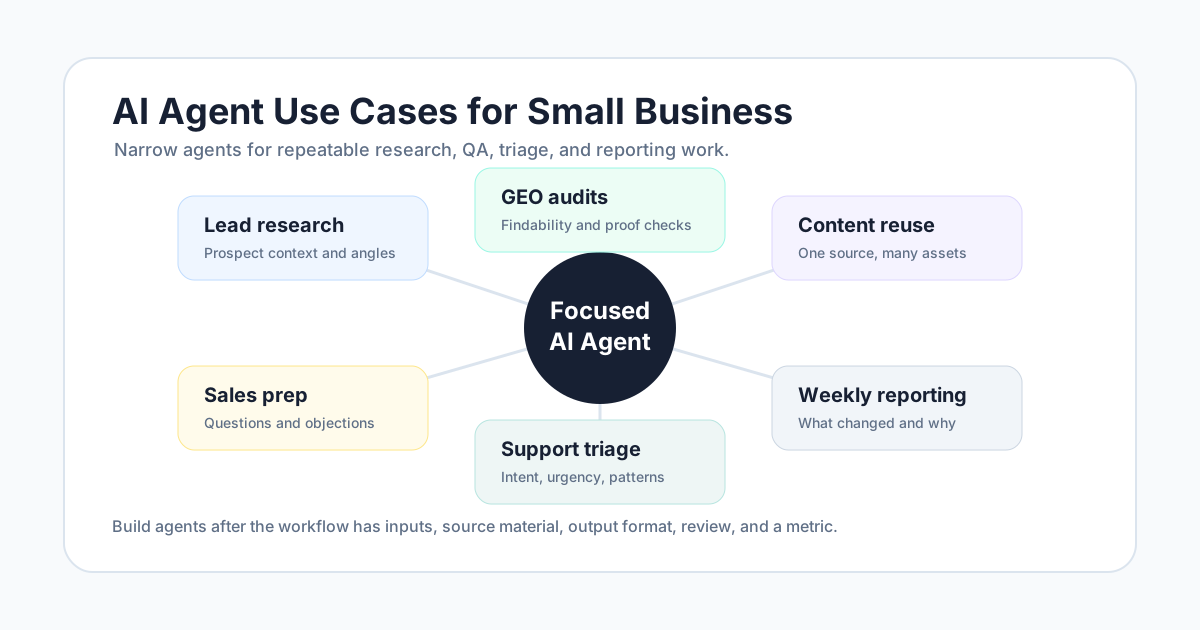
The most useful AI agents for small business handle narrow, repeatable jobs: lead research, GEO audits, content repurposing, sales prep, support triage, campaign QA, and weekly reporting.
Agents should not replace unclear processes
If a process is messy, an agent will only make the mess faster. Before building an agent, define the input, task, source material, approval rule, and output format.
Definition: AI agent for small business
An AI agent for small business is a focused assistant that uses defined inputs, source material, instructions, and review rules to complete a repeatable business task such as research, drafting, triage, QA, or reporting.
Seven useful first agents
1. Lead research agent
Summarizes a prospect's website, audience, offer, recent signals, likely pain points, and personalized outreach angle before a sales call or email.
2. GEO audit agent
Reviews a page for clarity, structured answers, proof, internal links, comparison content, FAQs, and citation-friendly sections.
3. Content repurposing agent
Turns one source asset into an article outline, newsletter, social posts, short video script, and sales enablement notes.
4. Sales prep agent
Uses CRM notes, form answers, and company research to prepare call questions, objections, proof points, and next-step suggestions.
5. Support triage agent
Groups support tickets by intent, urgency, product area, and recurring issue so the team can improve docs and prioritize fixes.
6. Campaign QA agent
Checks landing pages, emails, ads, and social posts for consistency, missing proof, weak CTAs, and claims that need verification.
7. Weekly reporting agent
Turns analytics, CRM notes, and publishing activity into a short weekly review: what changed, what worked, what to test next.
How to choose the first one
Pick the agent connected to your biggest bottleneck. If sales is slow, start with lead research. If content is inconsistent, start with repurposing. If AI search visibility is weak, start with a GEO audit agent.
What every agent needs
- A narrow job and a repeatable trigger.
- Trusted source material and clear permissions.
- A standard output format the team will actually use.
- A human review step for accuracy, privacy, and judgment.
- A metric such as time saved, lead quality, content shipped, or issues resolved.
Where tools and APIs fit
Once the use case is clear, you can decide whether the agent needs an automation tool, a model API, a vector database, a CRM integration, or only a reusable prompt. This is where future tool recommendations and affiliate offers can be useful without distracting from the business outcome.
Related resources
Explore the AI Lead Research Agent, AI Content Agent, and AI GEO Audit Agent. If you need a baseline first, use the AI-Ready Business Checker, GEO Checklist, AI Growth OS Starter Kit, and AI Visibility Audit.
FAQ
What are the best AI agent use cases for small business?
The best first use cases are lead research, GEO audits, content repurposing, sales prep, support triage, campaign QA, and weekly reporting.
When should a small business build an AI agent?
Build an agent after the workflow has clear inputs, trusted source material, an output format, a human review step, and a metric such as time saved or lead quality.
Free download
Free AI-Ready Business Checklist
Get a practical checklist for improving clarity, GEO readiness, lead capture, workflows, and measurement.